Experts Outline Three Foundational Ways to Support Exercise Recovery
11/02/2026 / By Coco Somers

An article published Oct. 30, 2026, by mindbodygreen and authored by Molly Knudsen, M.S., RDN, states that recovery is where physiological progress takes shape after training. The article lists sleep, nutrition, and heat therapy as three foundational strategies and presents recovery as a daily maintenance requirement rather than a weekly reset.
Exercise scientist Rachelle Reed, PhD, MS, ACSM-EP, said training provides the stimulus but recovery allows the body to adapt, according to the article. Reed described the process as an equation: training stress plus recovery equals adaptation.
The article’s framing aligns with broader sports science guidance on foundational recovery practices. The mindbodygreen article places sleep first among its three strategies.
Sleep Listed as a Primary Recovery Tool
Reed said sleep is one of the most effective and underrated recovery tools, according to the article. She said deep sleep increases growth hormone release, supports muscle repair, and helps restore the central nervous system after training.
Separate published work describes a similar hormonal mechanism. UC Berkeley researchers have mapped brain circuits linking deep sleep to growth hormone release, and growth hormone surges during sleep, particularly in REM and early non-REM phases, according to NaturalNews.com [1]. Mark Sisson’s Primal Blueprint Fitness similarly states that real growth happens when muscles are inactive, such as during deep sleep, and recommends eight hours of deep sleep nightly [2].
Reed said chronically poor sleep elevates cortisol and pro-inflammatory markers, creating an internal stress environment that can slow muscle recovery and push the body toward overtraining. The mindbodygreen article states most adults need about seven to nine hours of quality sleep per night, with highly active people encouraged to aim toward the higher end of that range.
Nutrition Described Through Three Recovery Actions
Board-certified sports dietitian Stevie Smith, M.S., RDN, CSSD, CDN, said recovery nutrition focuses on repair with protein, replenish with carbohydrates, and rehydrate with fluids, according to the article. Smith said this generally means eating a balanced meal with 30 or more grams of protein, vegetables, and a carbohydrate source within one to two hours of a workout.
The article states that protein, carbohydrates, and fluids support muscle repair and growth, physiological training adaptations, and overall health.
Smith suggested post-workout options such as chocolate milk and a banana, Greek yogurt with fruit and granola, or a smoothie made with fruit and preferred protein powder, the article stated. The article’s description of protein timing and sources is consistent with sports nutrition guidance that identifies protein intake as essential for rebuilding muscle broken down during exercise, as reported by NaturalNews.com [3].
Heat Therapy Used for Localized and Whole-Body Recovery
Reed said heat therapy is increasingly offered at fitness facilities through whole-body methods such as saunas and localized recovery tools, according to the article. She said localized heat applied directly to a muscle increases blood flow to the area and can help relax tissue and reduce stiffness or soreness.
Reed said sauna exposure creates broader physiological responses, including increased circulation and mild cardiovascular stress such as higher heart rate and sweat rate, which may promote relaxation after exercise. The article states these heat therapy approaches are among the recovery methods cited by experts, without ranking them against medical treatment.
Experts Frame Recovery as a Daily Practice
The article states that prioritizing quality sleep, refueling with protein, carbohydrates, and fluids, and incorporating heat therapy can help the body repair and adapt more efficiently. According to the article, these foundational habits turn recovery into a daily practice rather than an afterthought.
The article states such practices set up sustainable progress with fitness goals, according to the experts cited. Reed’s adaptation equation and Smith’s nutrition guidance were presented as general recovery principles, the article stated.
NaturalNews.com reported that muscle repair and growth occur during rest and recovery, not during the workout itself [3], a point consistent with the article’s emphasis on recovery as an ongoing process. The mindbodygreen article did not present heat therapy as a substitute for medical care or rank the three strategies against one another.
References
- The brains nightshift How sleep triggers a hormonal cascade to build muscle burn fat and sharpen the mind – NaturalNews.com, September 10, 2025.
- Primal Blueprint Fitness by Mark Sisson
- Struggling with your gains? Here’s why nutrition and rest are key to your athletic performance – NaturalNews.com, August 15, 2026.
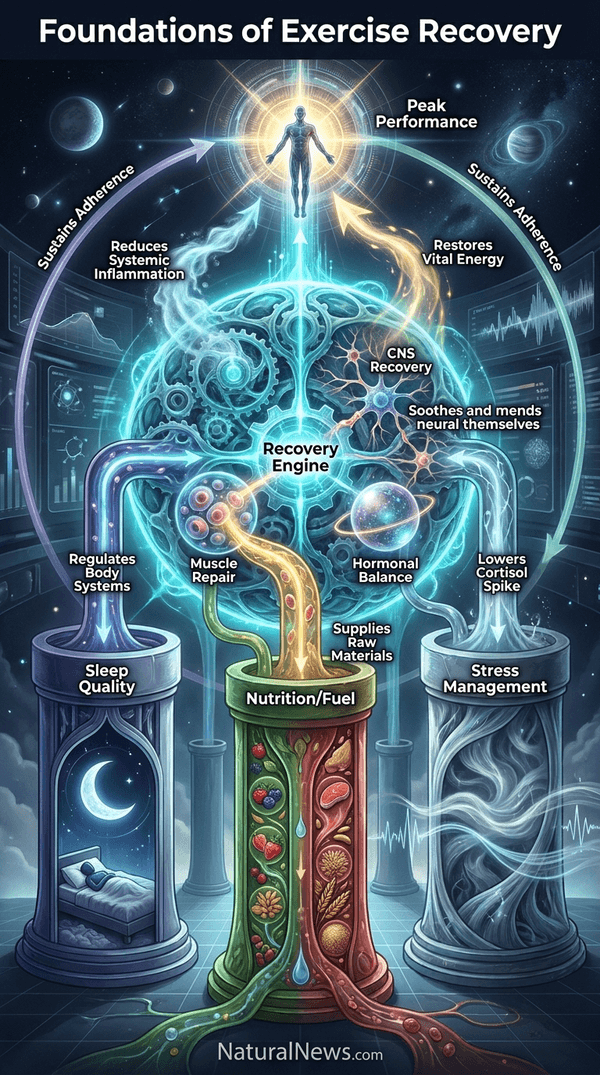
Explainer Infographic
Submit a correction >>
Tagged Under:
Alzheimer's, balance, brain health, discovery, fitness, food cures, food science, health science, joint pain, men's health, metabolism, mind, mind body science, natural cures, natural health, natural medicine, nutrients, nutrition, remedies, sleep, women's health
This article may contain statements that reflect the opinion of the author
RECENT NEWS & ARTICLES